IGCR Scheme Explained: 5 Powerful Ways Project Importers Cut Customs Duty
Setting up a new plant or expanding an existing one means importing machinery, equipment and project materials. On large imports, customs duty is one of the biggest costs, and it is often paid in full simply because the importer did not know a concession existed. The IGCR scheme was designed to fix exactly that.
In this guide, we explain what the IGCR scheme is, who can use it, how it compares with EPCG, MOOWR and Advance Authorisation, the steps and documents involved, and the mistakes that cost importers money.
What Is the IGCR Scheme?
The IGCR scheme works under the Customs (Import of Goods at Concessional Rate of Duty) Rules, 2017, usually shortened to IGCR. It lets eligible importers bring in specified goods at a concessional customs duty rate, instead of the normal rate, when the goods are for a qualifying project or purpose.
In simple terms, the IGCR scheme is a conditional duty concession. You get the lower rate, but you must register with Customs, give an undertaking (usually through a bond), use the goods only for the stated purpose, and keep proper records. If you break the conditions, the concession can be withdrawn and the duty recovered with interest and penalty.
Who Can Use the IGCR Scheme?
The IGCR scheme is mainly relevant to businesses that are:
- Setting up a new manufacturing unit or project
- Doing a substantial expansion of an existing unit
- Importing goods for a specified project or industry listed in the customs notification
Eligibility depends on the exact entry in the notification, the nature of your project, and the goods you import. Two businesses importing similar machines can get different results, so check the conditions for your own entry before you commit to an import. Our IGCR advisory team reviews this for manufacturers in Rajkot, Morbi and across India.
5 Powerful Ways the IGCR Scheme Cuts Customs Duty
1. Lower Upfront Duty on Project Goods
The most direct benefit of the IGCR scheme is the concessional rate itself. On high-value machinery imports, even a few percentage points of difference means lakhs, or crores, saved at the time of clearance.
2. Better Cash Flow During the Setup Stage
New projects are cash hungry. Land, construction, machinery and working capital all compete for the same funds. Paying less duty at the port keeps cash available for the stage when it matters most.
3. One Planned Framework for the Whole Project
Because the IGCR scheme is registered against a project, you can plan imports for the whole project under one structure, instead of treating every consignment as a separate transaction. This brings consistency to classification, documentation and compliance.
4. Fewer Disputes with Customs
A registered, well-documented import under the IGCR scheme is easier to defend than an ad hoc claim for a concession at the port. Clear paperwork upfront means fewer queries, fewer delays and a lower risk of a Show Cause Notice later.
5. Works Best with Correct Classification
The concession is tied to specific goods, so accurate HSN classification and a correct match to the notification entry are what protect your claim. Getting this right is the difference between a smooth clearance and a disputed one. Our customs classification and valuation advisory supports this step.
IGCR Scheme vs EPCG vs MOOWR vs Advance Authorisation
Many importers ask which scheme to use. The right answer depends on your business, so compare them first:
| Scheme | What it does | Export obligation? | Best for |
|---|---|---|---|
| IGCR scheme | Concessional duty on goods for eligible projects | No | New projects and expansions that qualify |
| EPCG | Zero or concessional duty on capital goods | Yes | Manufacturers with steady exports |
| MOOWR | Duty deferred until goods leave the bonded unit | No | Protecting working capital |
| Advance Authorisation | Duty-free import of inputs used for export products | Yes | Exporters importing raw materials |
The IGCR scheme stands out because it generally carries no export obligation, which makes it attractive for projects serving the domestic market. For a deeper look at the other schemes, read our posts on Advance Authorisation Scheme 2026 and 7 Myths About EPCG That Cost Exporters Lakhs.
How the IGCR Scheme Works: Step by Step
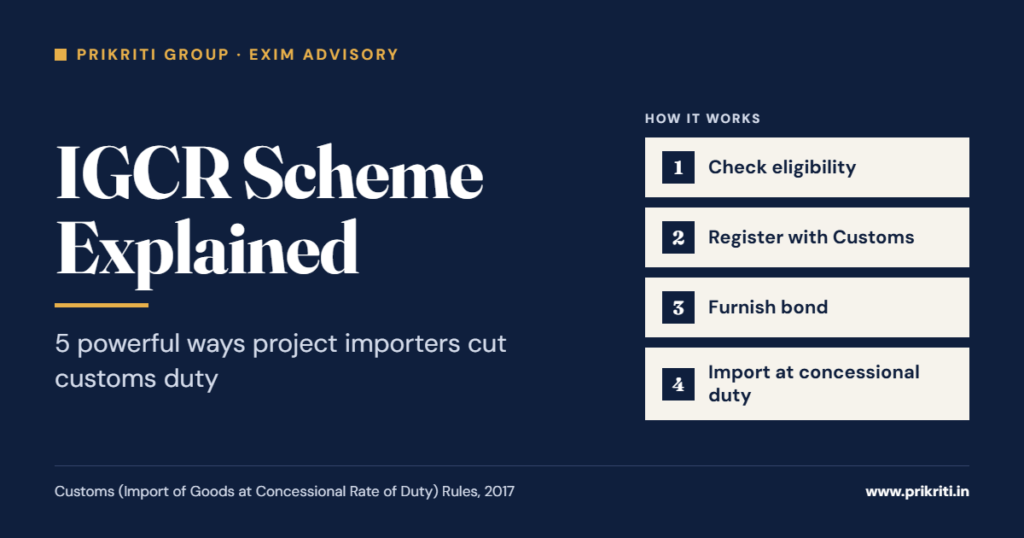
- Check eligibility. Identify the notification entry that matches your project and the goods you plan to import.
- Classify the goods. Confirm the HSN code for each item, since the concession depends on it.
- Register with Customs. Apply to the jurisdictional customs authority under the IGCR rules before the goods are imported.
- Furnish a bond or undertaking. This commits you to use the goods for the stated purpose.
- Import and claim the concession. Declare the scheme at the time of the Bill of Entry so the concessional rate is applied.
- Use the goods for the intended purpose. Install and use them in the registered project, and don’t sell or transfer them in breach of the conditions.
- Complete the post-import compliance. Submit the required proof and keep records for the period the rules prescribe.
The exact steps and timelines can vary with the notification entry and the Customs office, so confirm them for your case.
Documents Typically Needed Under the IGCR Scheme
Requirements differ by case, but a IGCR scheme application commonly involves:
- Registration application with the project details
- Project report or proof of the project (for example, approvals or a project description)
- Purchase order or contract with the supplier
- Commercial invoice, packing list and technical specifications
- IEC and GST registration details
- Bond or undertaking and any security required
- List of goods with HSN codes and the matching notification entry
Missing or inconsistent documents are the most common cause of delay, so assemble these early.
6 Common IGCR Scheme Mistakes to Avoid
- Registering too late. Registering after the goods arrive often means the concession is lost or delayed.
- Choosing the wrong HSN code or notification entry. A mismatch between the goods and the entry can sink the whole claim.
- Not matching goods to the project. Items that are not genuinely part of the project may not qualify.
- Ignoring post-import conditions. The concession depends on how you use the goods after clearance, not only on the import.
- Transferring or selling goods early. Breaking the usage conditions can trigger duty recovery with interest.
- Poor record keeping. If you can’t prove compliance, you can’t defend your claim.
Why Run a Pre-Import Audit Before Using the IGCR Scheme
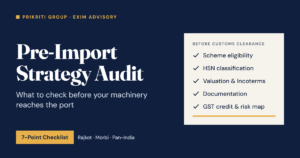
The IGCR scheme rewards planning. Most of the value is decided before the shipment is dispatched, because the registration, classification and documentation all have to be in place before clearance. A pre-import strategy audit tests your transaction against the IGCR scheme and the alternatives, so you pick the route with the best net benefit and the lowest risk. You can also read our full guide, Pre-Import Strategy Audit: The Ultimate 7-Point Checklist.
How PriKriti Group Helps with the IGCR Scheme
PriKriti Group is an EXIM advisory firm that has structured ₹900+ crore in duty savings across 1,500+ client mandates. For the IGCR scheme, we help you:
- Check whether your project and goods qualify
- Match each item to the right HSN code and notification entry
- Prepare the registration, bond and documents
- Plan the import so the concession is applied correctly at clearance
- Set up post-import compliance and records
Learn more on our IGCR advisory page.
Frequently Asked Questions About the IGCR Scheme
What is the IGCR scheme?
The IGCR scheme lets eligible importers bring in specified goods at a concessional customs duty rate for qualifying projects, under the Customs (Import of Goods at Concessional Rate of Duty) Rules, 2017.
Who is eligible for the IGCR scheme?
Businesses setting up new projects, or doing substantial expansion, that import goods listed in the relevant customs notification. Eligibility depends on the exact entry and conditions.
Does the IGCR scheme have an export obligation?
Generally no. This is a key difference from EPCG and Advance Authorisation, which carry export obligations.
Can I apply for the IGCR scheme after the goods arrive?
This is risky. Registration is normally done before import, and late applications can lose the concession. Plan before you ship.
What happens if I break the IGCR scheme conditions?
The concession can be withdrawn, and the duty may be recovered with interest and penalty. Follow the usage and record-keeping conditions carefully.
Is the IGCR scheme better than EPCG or MOOWR?
It depends on your project. The IGCR scheme suits qualifying projects without export plans, EPCG suits steady exporters, and MOOWR suits businesses that want to defer duty. A short comparison before you import will show which gives the best net benefit.
 by
