
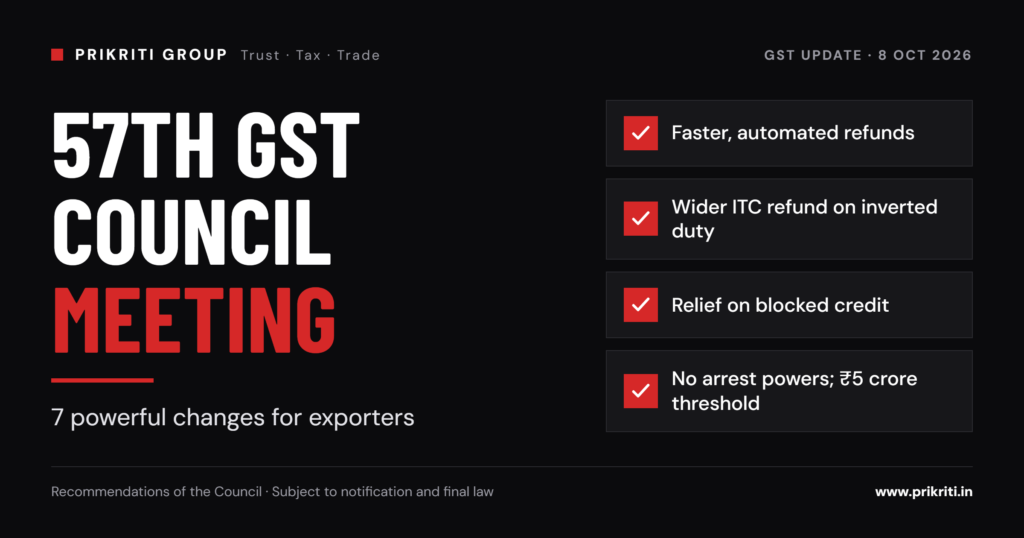
57th GST Council Meeting: 7 Essential Changes for Exporters & Manufacturers
The 57th GST Council meeting, held on 8 October 2026 at Bharat Mandapam in New Delhi, was a process-reform meeting. The 56th meeting in 2025 reshaped GST rates. This time, the Council looked at refunds, input tax credit, enforcement, litigation and compliance.
For exporters and manufacturers, that is welcome news. Delayed refunds, blocked credit and fear of notices are the problems that hurt cash flow most. The 57th GST Council meeting recommendations address all three.
Important: These are Council recommendations. They take effect only after they are notified or enacted. Read this article as a guide to what is coming, not as a final legal position.
What Was the 57th GST Council Meeting About?
The 57th GST Council meeting was the first Council meeting in more than a year. The Council recommended reforms covering registration, returns, refunds, input tax credit (ITC), dispute resolution, exports and enforcement, along with a few clarifications on specific goods and services.
The main theme was automation and fewer interactions with tax officers. The Council aimed to remove the procedural bottlenecks that cause most GST disputes and delays.
The 7 Changes at a Glance
| # | Change | Who benefits most |
|---|---|---|
| 1 | Faster, more automated refunds | Exporters |
| 2 | Wider refund of accumulated ITC (inverted duty) | Manufacturers |
| 3 | Fewer export-related hurdles | Exporters |
| 4 | Relief on blocked ITC | All businesses |
| 5 | No arrest powers; higher prosecution threshold | All businesses |
| 6 | Lower general penalty (as reported) | All businesses |
| 7 | Simpler compliance for small taxpayers | MSMEs and small traders |
Change 1: Faster and More Automated GST Refunds
Refunds were one of the biggest areas of reform in the 57th GST Council meeting. The recommendations point to more automation, so that eligible claims move faster with less manual scrutiny. Reports of the announcement also mention quicker acknowledgment of refund applications and risk-based provisional refunds for eligible claims.
Why it matters: an exporter with money stuck in IGST or ITC refunds is effectively financing the government. Faster refunds directly improve working capital, which is why this change tops the list.
Change 2: Wider Refund of Accumulated ITC Under Inverted Duty
An inverted duty structure arises when a manufacturer pays more GST on inputs than it charges on the finished product, so credit piles up. The 57th GST Council meeting recommended widening refunds in these cases:
- Input services: refund of accumulated ITC on input services is recommended for credit availed on or after 1 November 2026.
- Capital goods: refund of ITC on capital goods, in both zero-rated supply and inverted duty cases, would be spread over 60 months, for credit availed on or after 1 April 2027.
Why it matters: until now, credit on services and capital goods was often stuck in these cases. For capital-heavy manufacturers, this could release significant cash over time.
Change 3: Fewer Export-Related Hurdles
The 57th GST Council meeting also addressed barriers that exporters face in treating supplies as zero-rated. Commentary on the meeting points to the removal of certain conditions, including the distinct-person condition for some export services.
Why it matters: each condition removed means fewer rejected refund claims and fewer disputes with officers. Check the final notification to see exactly which transactions are covered.
Change 4: Relief on Blocked Input Tax Credit
Blocked credit under Section 17(5) has caused years of litigation. The 57th GST Council meeting recommended relief for several categories, including:
- Health and life insurance
- Telecom towers and certain pipelines
- Specified free samples and destroyed stock
- Expired goods
- Limited credit for outdoor catering and restaurant services in the same line of business
Why it matters: ITC that was previously lost may become claimable. The conditions will matter, so wait for the legal text before changing your books.
Change 5: No Arrest Powers and a Higher Prosecution Threshold
Among the strongest messages from the 57th GST Council meeting was a move toward lighter enforcement. The Council recommended withdrawing the arrest power under Section 69 and raising the threshold for prosecution to ₹5 crore.
Why it matters: a business owner’s biggest fear in a GST dispute is personal liability. If enacted, this reduces litigation stress and lets management focus on operations.
Change 6: Lower General Penalty (As Reported)
Reports and summaries of the 57th GST Council meeting mention a reduction in the general penalty from ₹25,000 to ₹10,000. Confirm this against the official press release and final amendment before you rely on the figure.
Why it matters: even small penalties add up for businesses with many minor filing lapses. A lower penalty means a lower cost for honest mistakes.
Change 7: Simpler Compliance for Small Taxpayers
The 57th GST Council meeting also proposed ease-of-doing-business measures:
- Auto-matching of purchase and sales invoices between buyers and sellers
- Less paperwork for ITC claims
- Fewer return filings for small traders
- No separate registration in each state for certain small taxpayers
Why it matters: compliance cost is a real burden for MSMEs. Automation reduces errors and mismatches, which are common causes of notices.
What the 57th GST Council Meeting Means for Exporters
Exporters gain the most in cash flow. Faster refunds, fewer conditions on zero-rated supplies and wider ITC refunds can shorten the cash cycle. Exporters should also review their IGST refund history, shipping bill and GSTR data matching, and any pending refund claims. If you also import capital goods, our pre-import strategy audit work can help you align duty and GST planning together.
What the 57th GST Council Meeting Means for Manufacturers
Manufacturers in inverted duty sectors may see accumulated credit released over time. Those who buy machinery or pay for services such as insurance may also unlock previously blocked credit. Manufacturers should run an ITC health check now: how much credit is accumulated, in which category, and under which section.
5 Steps to Take Now
- Wait for the notifications. Do not change returns or claims until the changes are legally notified.
- Review your accumulated ITC. Separate input goods, input services and capital goods, since the rules differ.
- Audit your refund backlog. List pending refund claims, rejection reasons and match them with shipping bill data.
- Check blocked-credit categories. Identify credit you reversed or never claimed that may become eligible.
- Get expert review. Ask a GST advisor to model the cash flow impact on your business.
Frequently Asked Questions
What is the 57th GST Council meeting?
The 57th GST Council meeting was held on 8 October 2026 in New Delhi. It recommended process reforms on refunds, ITC, registration, returns, enforcement and dispute resolution.
Are the 57th GST Council meeting decisions law now?
No. They are recommendations. They become law only after notifications or amendments to the GST Acts.
How does the 57th GST Council meeting help exporters?
It recommends faster and more automated refunds, fewer export-related conditions, and wider refund of accumulated ITC, which can improve exporters’ working capital.
Did the 57th GST Council meeting change GST rates?
The meeting focused on process reform rather than broad rate changes, though it clarified the treatment of a few specific goods and services.
What should manufacturers do after the 57th GST Council meeting?
Review accumulated ITC, check blocked-credit categories, clean up refund backlogs, and wait for the official notifications before acting.
 by
