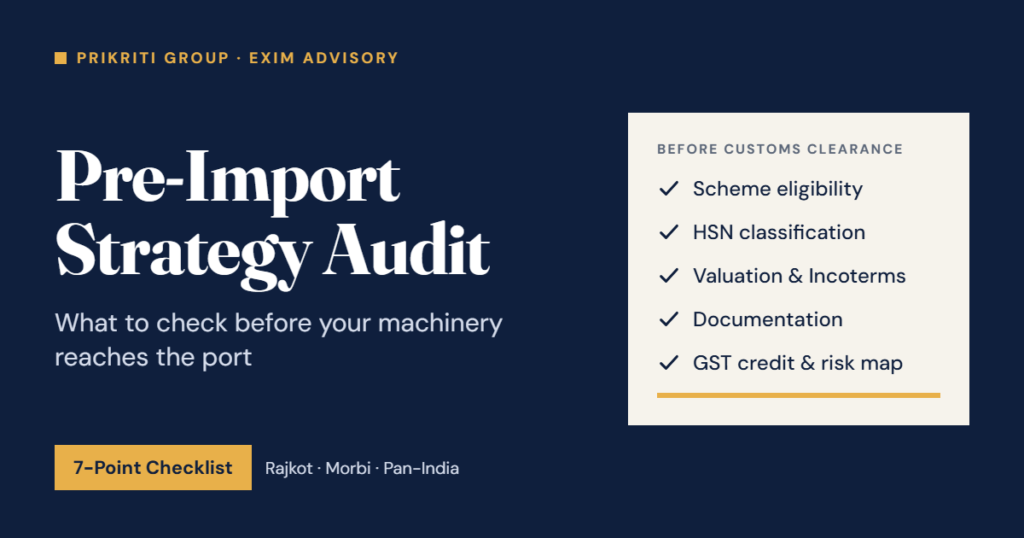
Pre-Import Strategy Audit: What to Check Before Your Machinery Reaches the Port
Every year, Indian manufacturers pay lakhs, and sometimes crores, in customs duty that they never needed to pay. The reason is rarely bad intent. It is a lack of planning at the one moment when savings are still possible: before the goods reach the port. A pre-import strategy audit is built to fix exactly that.
Once your machinery is on the water, your options narrow. The Bill of Entry is filed, the HSN code is declared, and the duty is calculated. Fixing a mistake after clearance means paying first and fighting later.
That is why every importer should treat a pre-import strategy audit as standard practice. In this guide, we explain what it is, why it matters for capital goods importers, and the seven checks to run before an import shipment arrives.
What Is a Pre-Import Strategy Audit?
A pre-import strategy audit is a structured review of your import transaction before customs clearance and before any duty is paid. It looks at the whole transaction (the commercial terms, the scheme you can use, the classification of the goods, the valuation, and the compliance risk) and answers one question: are you importing in the most duty-efficient and legally safe way?
It is different from a post-import audit or a customs notice reply, which both react to problems that have already happened. A pre-import strategy audit prevents the problem. The output is practical and usable by your finance and operations teams:
- A duty saving model comparing the schemes available to you
- A scheme fit report with a clear recommendation
- An import risk map covering classification, valuation, and compliance exposure
- An execution roadmap with timelines and responsibilities
Why Machinery Importers Need a Pre-Import Strategy Audit
Capital goods imports involve large values, and a small error is multiplied by those values. A one-percentage-point error in the duty rate on a ₹10 crore machinery import is ₹10 lakh. A wrong scheme choice can lock up working capital for years.
Three things make machinery imports especially risky:
- Complex classification. Multi-axis machining centres, production lines, and machines imported in parts can fall under more than one tariff heading, and the wrong choice invites a dispute.
- Multiple schemes. EPCG, MOOWR, IGCR, and Advance Authorisation each work differently, and the cheapest option on paper is not always the best fit for your cash flow and export plans.
- Strict timing. Many benefits must be structured before import. Once the goods are cleared under the wrong route, it is often too late.
The 7-Point Pre-Import Strategy Audit Checklist
Check 1: Scheme Eligibility (EPCG, MOOWR, IGCR, Advance Authorisation)
This is where the biggest savings usually are, so start here in every pre-import strategy audit. Ask which schemes your import qualifies for and how they compare.
- EPCG allows import of capital goods at zero or concessional duty in return for an export obligation, typically 6 times the duty saved over 6 years. It suits manufacturers with steady export plans.
- MOOWR (Manufacture and Other Operations in Warehouse Regulations) defers duty until goods leave the bonded unit. It suits businesses that want to protect working capital without an export obligation.
- IGCR (Import of Goods at Concessional Rate of Duty Rules) gives a concessional duty rate for eligible projects and industries.
- Advance Authorisation allows duty-free import of inputs used to make export products.
The right choice depends on your export volumes, cash flow, product mix, and risk appetite. Read our post on 7 Myths About EPCG That Cost Exporters Lakhs before you decide, since several common beliefs about the scheme are wrong.
Check 2: HSN Classification of the Machinery
The HSN (tariff) code decides your duty rate, your eligibility for exemptions, and your risk of dispute. Verify the following:
- Does the chapter and heading match the machine’s actual function and technical specification?
- Is the equipment imported complete, or as parts and sub-assemblies that may be classified differently?
- Does the classification on the supplier’s invoice match what you plan to declare to customs?
- Have there been rulings or circulars on similar machines?
Classification disputes are among the costliest import problems. A Morbi vitrified tile manufacturer we advised faced a ₹6.75 crore duty risk from a disputed classification. Fixing it before the consignment was filed removed the exposure entirely. Our customs classification and valuation advisory team reviews this before filing.
Check 3: Customs Valuation and Incoterms
Customs duty is calculated on assessable value, not just the invoice price. Your Incoterms decide which costs are added to that value. For example, freight and insurance are generally included in the assessable value, so a CIF or CFR contract will look different from an FOB one.
Review these points:
- Which Incoterm is in the contract, and does it suit your import plan?
- Are royalties, license fees, commissions, or assists included in the value where required?
- Is the price paid the real transaction value, supported by the contract and bank records?
- Does the payment structure match the invoice?
Undervaluation allegations lead to re-assessment, penalties, and long disputes. A consistent, well-documented valuation protects you.
Check 4: Import Documentation Completeness
Weak documentation causes delays, demurrage, and notices. Before shipment, confirm you have:
- A commercial invoice with a full machine description and technical specifications
- A packing list that matches the invoice
- The contract or purchase order with terms of sale
- Bank and payment documents
- Catalogues, technical write-ups, or manufacturer certificates supporting your classification
- The licences, authorisations, or scheme documents required for your chosen route
A document gap discovered at the port costs far more than one found in advance.
Check 5: Duty Impact vs Export Obligation Risk
A scheme that saves duty today can create obligations tomorrow. For EPCG, you must meet the export obligation within the stated period, and missing it can mean paying the duty back with interest. Model both sides:
- How much duty will you save upfront?
- Can your export plans realistically support the obligation?
- What happens to your cash flow and compliance burden in each year of the scheme?
- Is a duty deferment route like MOOWR a safer fit if your exports are uncertain?
The best choice is the one that delivers the highest net benefit after accounting for the risk, not the one with the biggest headline saving.
Check 6: GST Input Tax Credit on Import Duties
Import duty planning is incomplete without GST. Check whether the IGST paid on the import is eligible as input tax credit, what conditions apply, and whether any blocked credit risk exists. Many businesses lose working capital to credit that sits unclaimed or is reversed later. If you also have an older refund backlog, our GST advisory and litigation team can help.
Check 7: Compliance Risk and Dispute Exposure
The final check ties everything together. Map where the transaction could attract a query or a Show Cause Notice: classification, valuation, scheme conditions, or documentation. A good pre-import strategy audit assigns each exposure a level (low, medium, or high) and an action to close it before the goods ship.
When Should You Do a Pre-Import Strategy Audit?
Do it before you place the purchase order or sign the contract if possible, and no later than before the shipment is dispatched. Early involvement gives you the most flexibility on Incoterms, scheme choice, and documentation. Once goods have arrived and a Bill of Entry is filed, most of your options are gone.
Run a pre-import strategy audit if any of these apply:
- You are importing capital goods or machinery above a meaningful value
- You are importing for the first time or entering a new product category
- Your machine could fit more than one tariff heading
- You export, or plan to, and want to use EPCG or Advance Authorisation
- You have faced a customs query or notice before
How PriKriti Group Runs a Pre-Import Strategy Audit
Our process has four stages:
- Transaction discovery: we review your invoice, contract, Incoterms, banking terms, and supplier relationship.
- Scheme eligibility analysis: we assess EPCG, MOOWR, IGCR, Advance Authorisation, and other DGFT schemes for fit, benefit, and obligation risk.
- HSN and valuation review: we examine classification and valuation to reduce post-import dispute exposure.
- Report and roadmap: you receive a duty saving model, scheme fit report, risk map, and an execution plan for your team.
PriKriti Group has structured ₹900+ crore in duty savings across 1,500+ client mandates, working with manufacturers and exporters from our offices in Rajkot and Morbi, with clients across India.
Frequently Asked Questions
What is a pre-import strategy audit?
A pre-import strategy audit is a review of your import transaction before customs clearance. It checks scheme eligibility, HSN classification, valuation, documentation, and compliance risk so you can reduce duty and avoid disputes.
When should I do a pre-import strategy audit?
Ideally before you finalise the purchase contract, and at the latest before the shipment is dispatched. After the Bill of Entry is filed, most options are closed.
Is a pre-import strategy audit only for large importers?
No, but it matters most when the import value is high, the classification is complex, or you are considering a scheme like EPCG or MOOWR. Even a mid-sized machinery import can involve lakhs in potential savings or risk.
What documents do I need?
Typically the commercial invoice, purchase order or contract, packing list, technical specifications or catalogues, and your IEC and GST details. Your advisor will confirm the exact list for your import.
Can a pre-import strategy audit really reduce my customs duty?
It can identify legal ways to lower or defer duty, such as the right scheme or the correct classification. It does not change what the law allows. It makes sure you use all of it.
What if I have already imported the goods?
Some issues can still be corrected through amendments, appeals, or refund claims, but options are narrower. A post-import review is still worth doing.
Conclusion
Duty savings are decided before the machinery lands, not after. A pre-import strategy audit gives you a clear view of the scheme, classification, valuation, and risk picture while you can still act on it. Seven checks, done early, can save lakhs and protect you from disputes that would otherwise take months to resolve.
Planning to import machinery or capital goods? Get a free review of your transaction before it reaches the port.
 by
